Tuesday, 24 July 2012

Cichlasoma Nigrofasciatum

Cichlasoma Nigrofasciatum

As a juvenile, the Managua Cichlid can be housed in a 50 gallon minimum aquarium. The adult requires an aquarium no smaller then 70 gallons. It requires plenty of open swimming room, as well as places to hide. The bottom of the tank should be coarse gravel, without plants, as the Managua Cichlid is a burrower and will tear up plants.
Although this cichlid is a predator, it can be housed with other large cichlids, but sometimes, will not tolerate other cichlids that are similar in color. Any fish that will fit into its mouth should not be kept in the same aquarium with the Managua Cichlid.
The male is generally larger and has pointed dorsal and anal fins, as well as being more brightly colored. Breeding in an aquarium is often difficult, but Managua Cichlids are excellent parents and form nuclear families. The female can spawn up to 5,000 yellow eggs

Cichlasoma Nigrofasciatum

Cichlasoma Nigrofasciatum

Cichlasoma Nigrofasciatum

Cichlasoma Nigrofasciatum

Cichlasoma Nigrofasciatum
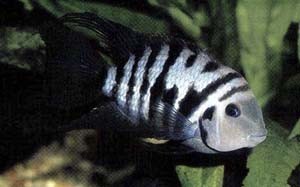
Cichlasoma Nigrofasciatum

Cichlasoma Nigrofasciatum

Cichlasoma Nigrofasciatum
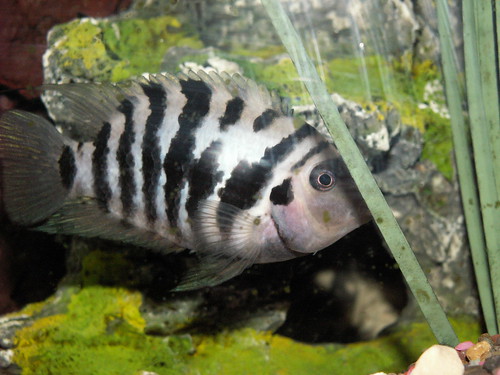
Cichlasoma Nigrofasciatum
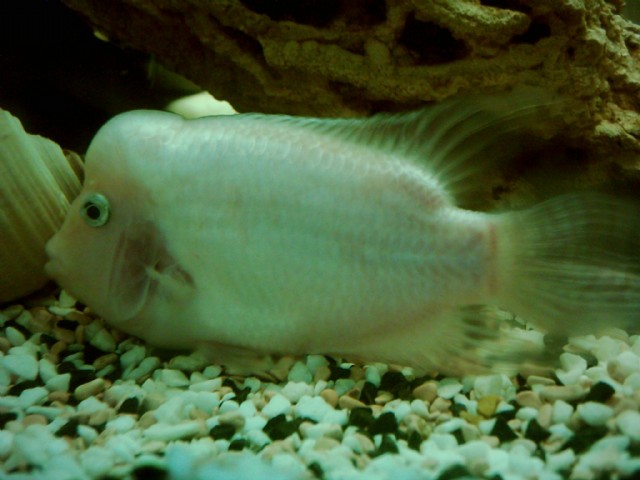
Cichlasoma Nigrofasciatum
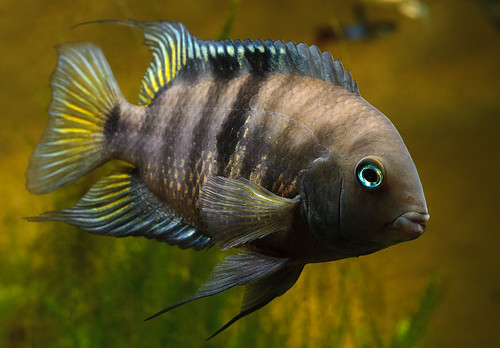
Cichlasoma Nigrofasciatum

Cichlasoma Nigrofasciatum
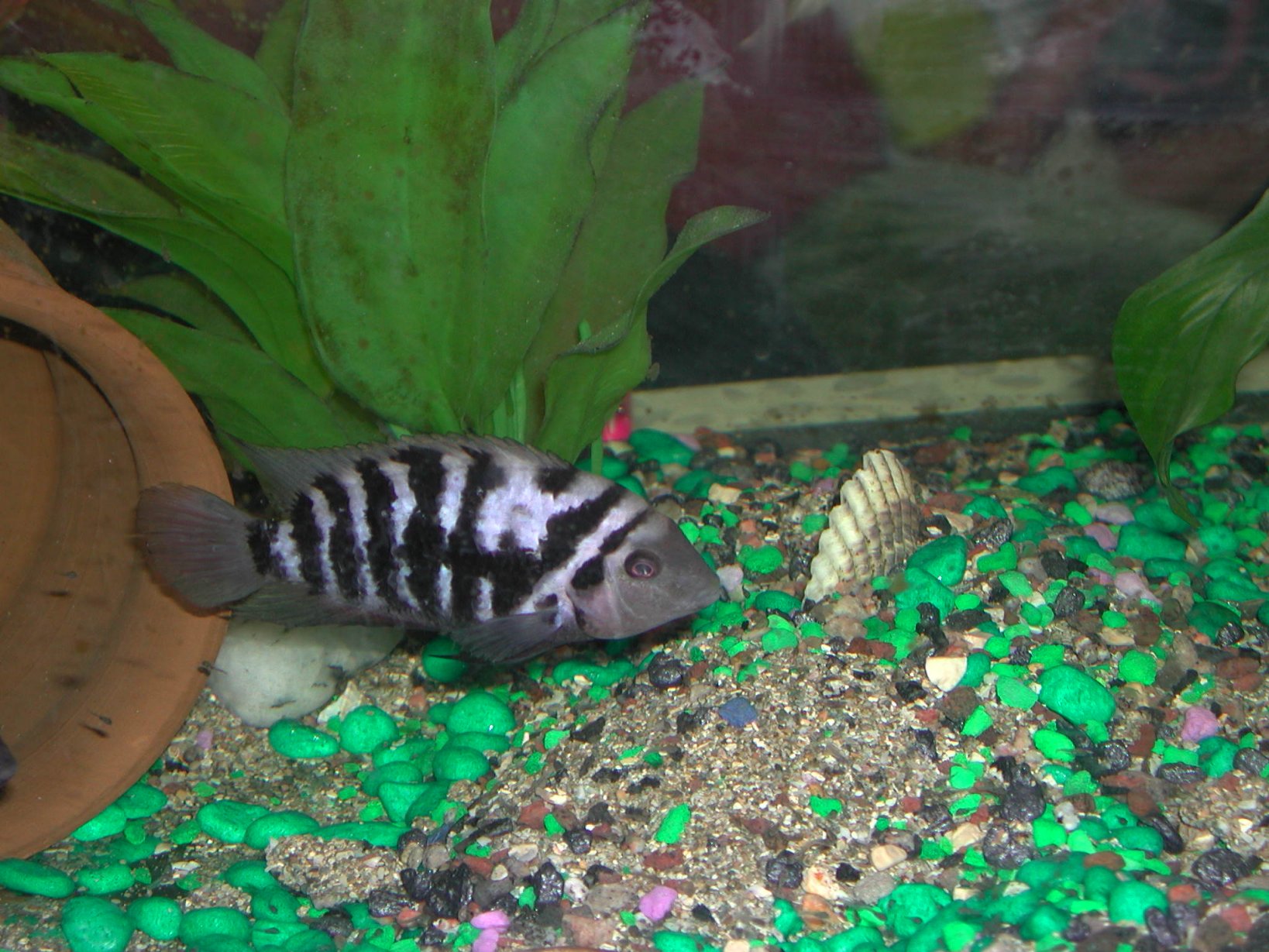
Cichlasoma Nigrofasciatum

Cichlasoma Nigrofasciatum
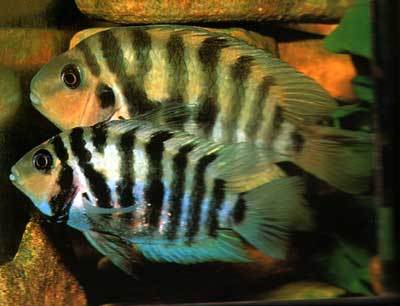
Cichlasoma Nigrofasciatum
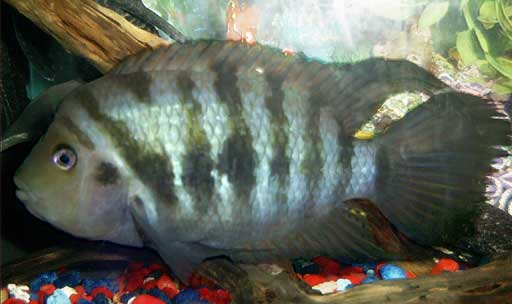
Cichlasoma Nigrofasciatum

Cichlasoma Nigrofasciatum


Cichlasoma Managuense

Cichlasoma Managuense

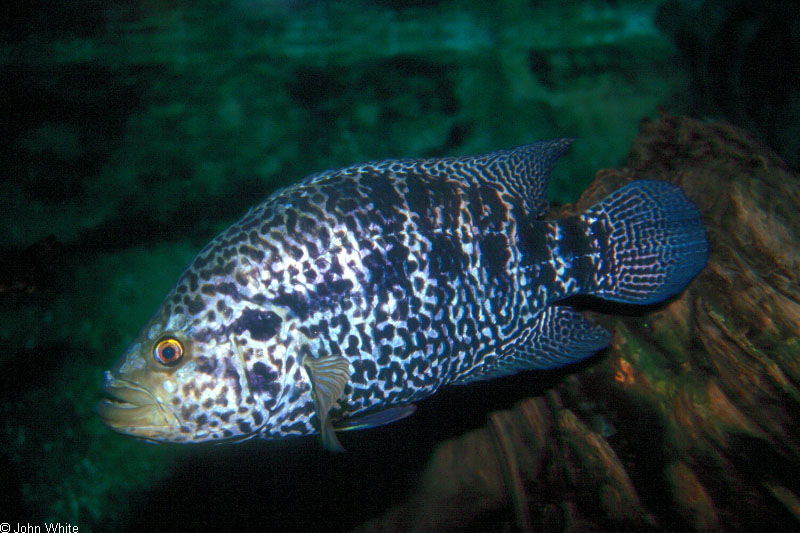
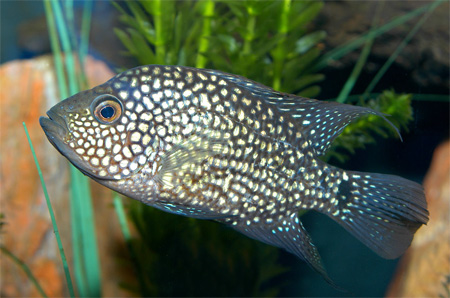
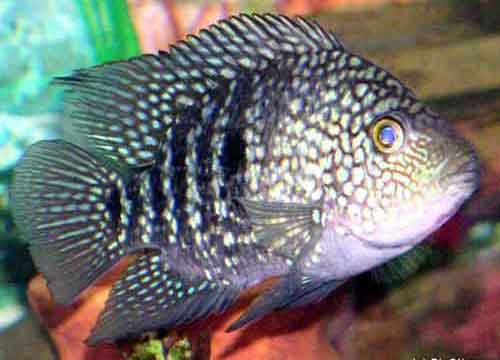
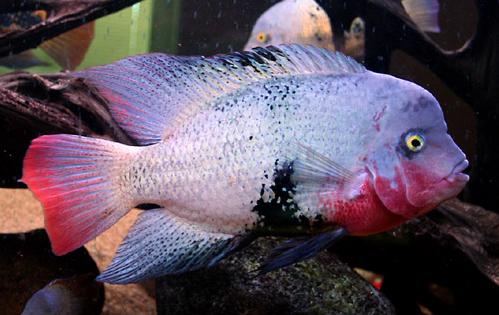
The Managua Cichlid, also known as the Aztec Cichlid and the Jaguar Cichlid, is a beautifully marked cichlid. Young Managua Cichlids are dull silver/gold with spots running along their bodies. As they mature, they become duller. When sexually mature, the drab blotches become darker, eventually turning black with an irregular pattern like that of the jaguar cat. The background color is pearly with a light purple cast. The blotches are less extreme in females. The lower lip often extends up over the upper lip, sometimes revealing some of the front teeth.
As a juvenile, the Managua Cichlid can be housed in a 50 gallon minimum aquarium. The adult requires an aquarium no smaller then 70 gallons. It requires plenty of open swimming room, as well as places to hide. The bottom of the tank should be coarse gravel, without plants, as the Managua Cichlid is a burrower and will tear up plant

Cichlasoma Managuense

Cichlasoma Managuense

Cichlasoma Managuense

Cichlasoma Managuense

Cichlasoma Managuense

Cichlasoma Managuense

Cichlasoma Managuense

Cichlasoma Managuense

Cichlasoma Managuense

Cichlasoma Managuense

Cichlasoma Managuense

Cichlasoma Managuense

Cichlasoma Managuense

Cichlasoma Managuense

Cichlasoma Managuense

Cichlasoma Managuense

Cichlasoma Managuense


Cichlasoma Cyanoguttatum

Cichlasoma Cyanoguttatum

It differs from congeneric species from freshwater and estuarine mugilid, cichlid, and gobiid fishes, previously placed to Saccocoelioides Szidat, 1954, and Carassotrema Park, 1938, in possessing the intestinal ceca reaching up to the posterior half of the testis and a bipartite, swollen external seminal vesicle. The new species also is characterized by a small, pyriform body, a well-developed prepharynx, a large pharynx, extensive vitelline follicles, confluent posterior to the testis that is situated near the posterior extremity, a uterus limited to the pretesticular and postacetabular region, and few, but relatively large, eggs (67-81 x 36-47 microm, i.e., about 12-14% of the body length) and miracidia without eye-spots. Culuwiya cichlidorum is also reported from Tomocichla tuba (Meek) in Nicaragua and species of Cichlasoma, Herichthys, Oreochromis, Parachromis, Petenia, Theraps, and Vieja from Mexico

Cichlasoma Cyanoguttatum

Cichlasoma Cyanoguttatum

Cichlasoma Cyanoguttatum

Cichlasoma Cyanoguttatum

Cichlasoma Cyanoguttatum

Cichlasoma Cyanoguttatum

Cichlasoma Cyanoguttatum

Cichlasoma Cyanoguttatum

Cichlasoma Cyanoguttatum

Cichlasoma Cyanoguttatum

Cichlasoma Cyanoguttatum

Cichlasoma Cyanoguttatum

Cichlasoma Cyanoguttatum

Cichlasoma Cyanoguttatum

Cichlasoma Cyanoguttatum

Cichlasoma Cyanoguttatum

Cichlasoma Cyanoguttatum


Cichlasoma Maculicauda

Cichlasoma Maculicauda

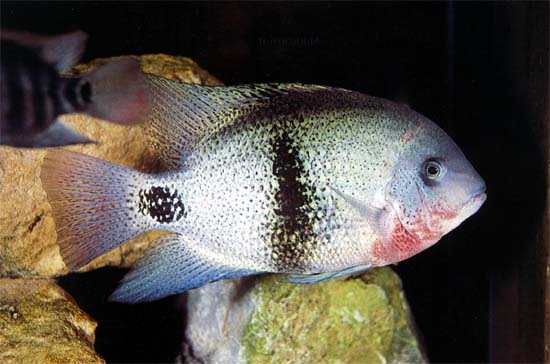
A new haploporid trematode, Culuwiya cichlidorum n. sp., is described from the intestine of the black-belt cichlid Vieja maculicauda (=Cichlasoma maculicauda (Regan)) from the Atlantic coast of Nicaragua. It differs from congeneric species from freshwater and estuarine mugilid, cichlid, and gobiid fishes, previously placed to Saccocoelioides Szidat, 1954, and Carassotrema Park, 1938, in possessing the intestinal ceca reaching up to the posterior half of the testis and a bipartite, swollen external seminal vesicle. The new species also is characterized by a small, pyriform body, a well-developed prepharynx, a large pharynx, extensive vitelline follicles, confluent posterior to the testis that is situated near the posterior extremity, a uterus limited to the pretesticular and postacetabular region, and few, but relatively large, eggs (67-81 x 36-47 microm, i.e., about 12-14% of the body 

Cichlasoma Maculicauda

Cichlasoma Maculicauda

Cichlasoma Maculicauda

Cichlasoma Maculicauda

Cichlasoma Maculicauda

Cichlasoma Maculicauda

Cichlasoma Maculicauda

Cichlasoma Maculicauda

Cichlasoma Maculicauda

Cichlasoma Maculicauda

Cichlasoma Maculicauda

Cichlasoma Maculicauda

Cichlasoma Maculicauda

Cichlasoma Maculicauda

Cichlasoma Maculicauda

Cichlasoma Maculicauda

Cichlasoma Maculicauda